
Hillsborough County Court Records After a Jail Arrest
Once someone is arrested and booked in Hillsborough County, the case does not become a court record on its own. The Office of the State Attorney for the Thirteenth Judicial Circuit reviews what law enforcement submits and decides which charges to file. That filing opens the court case and creates the court record. Susan S. Lopez is the State Attorney, and the office covers all of Hillsborough County, including Tampa, Temple Terrace, and Plant City. The clerk of court then keeps the filed record and tracks it through to disposition.
The arrest and the court record are two different things. For the booking side, the roster and booking detail live on the jail inmate records page, and booking photos are covered on the jail mugshots page. The court record is the set of charges the prosecutor actually filed, tracked through the clerk's case index. HCSO warns plainly that its arrest data may not reflect the State Attorney's charging decisions or the outcome of a trial, which is exactly why the court record matters after an arrest.
How to Find Hillsborough County Court Records After an Arrest
Court case records for Hillsborough County are searched through HOVER, the clerk's online case-search portal. A criminal case is usually found by defendant name or by case number from bond or court paperwork. The roster gives you the name spelling and booking date to start with, and HOVER shows the filed charges, case number, court dates, and disposition.
- Start at the HCSO Arrest Inquiry to capture the exact name, booking date, and arrest charges.
- Open the Hillsborough Clerk HOVER portal and search by defendant name or case number.
- Open the criminal case and read the filed charge list, count by count.
- Check each charge's statute, level, and current status, and note the filing date and court division.
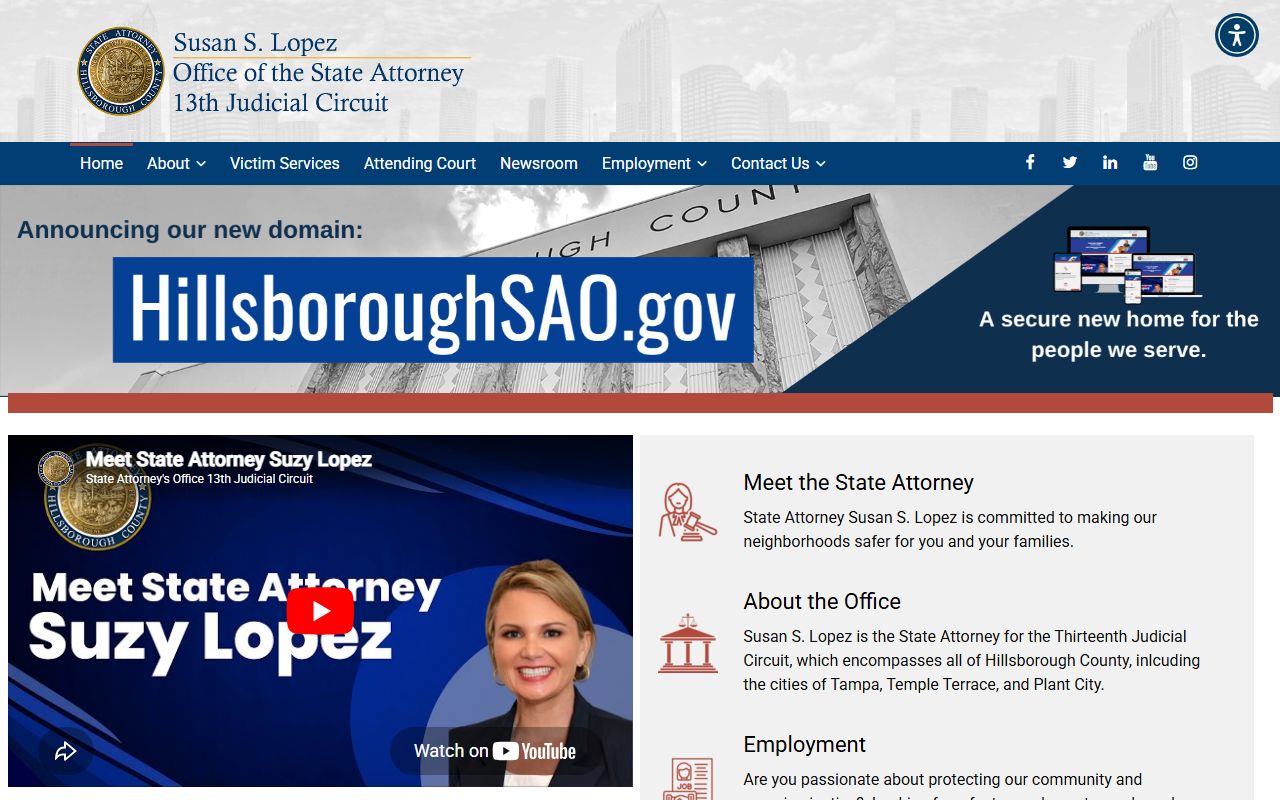
The prosecutor's office is the charging authority behind those records. A look at the State Attorney, Thirteenth Judicial Circuit homepage shows the office's jurisdiction over Hillsborough County and its Tampa and Plant City contact details.
For statewide criminal history rather than a single case, HCSO points to FDLE public records at 850-410-8109 and the FDLE search site, a separate path from the free clerk search.
How Charges Get Filed After an Arrest: Complaint, Information, and Indictment
The path runs forward from the arrest. Booking happens at the jail, then the charge record begins when the prosecutor files a charging document. In Florida, most felony and misdemeanor cases are charged by an information filed by the State Attorney, while serious cases can be charged by a grand jury indictment. An early complaint or affidavit may support the arrest before the formal charge is filed.
| Complaint | Information | Indictment | |
|---|---|---|---|
| Filed By | Officer / early charging | State Attorney | Grand Jury |
| Common For | Arrest support | Many felonies and misdemeanors | Serious felonies |
| Starts | Supports the arrest | The court case | The court case |
A later amended information can change counts or statute language after the first filing, and a nolle prosequi means the prosecutor declined to proceed. None of these documents is created by the jail, which is why the arrest charge on the roster can read differently from the filed court charge.
Charge Status in the Court Record After an Arrest
Charges shift as a case moves. The booking charge on the jail roster is the law-enforcement allegation. The court charge can be amended, reduced, added to, or dropped after the prosecutor reviews the case. Reading the status of each count is how a court record tells you where a case really stands, so the terms below are worth knowing.
| Status | What It Means |
|---|---|
| Pending | The filed case or count is not yet resolved. |
| Amended / Reduced | Charge language, counts, or severity changed after filing. |
| Dismissed | The court or prosecutor ended the charge without a conviction. |
| Nolle Prosequi | The prosecutor decided not to proceed on the charge. |
Note: a roster bond and an open court case can lag each other, so a charge can appear filed in HOVER while the roster still shows the original arrest charge.
Bond and Release After an Arrest
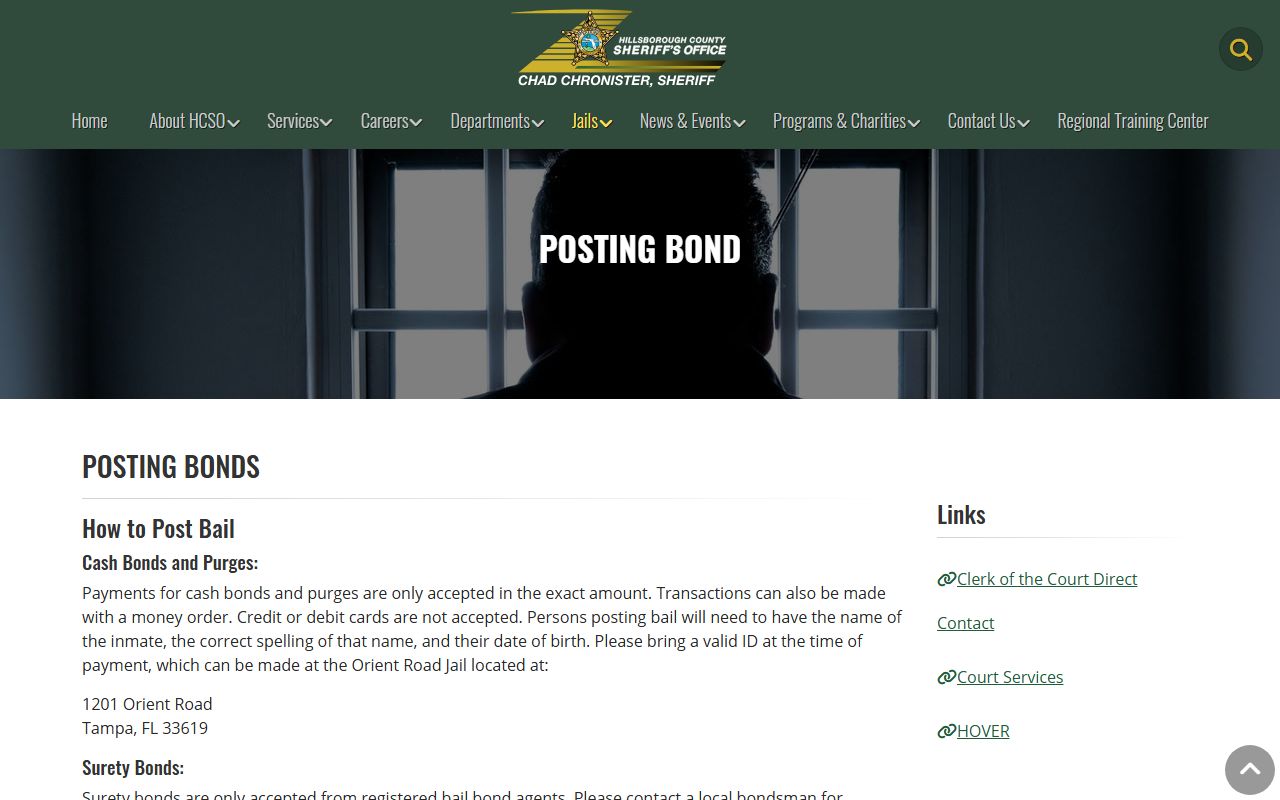
Bond is set at or before first appearance, and the jail roster may show the bond amount listed at booking. HCSO accepts cash bonds and purges only in the exact amount, takes money orders, and does not accept credit or debit cards. The person posting needs the inmate's correctly spelled name, date of birth, and a valid ID, and cash bonds and purges are paid at Orient Road Jail. Surety bonds are posted only through a registered bail bond agent. A hold or detainer from another agency can keep a person in custody even when bond is posted.
| Bond Type | How It Works |
|---|---|
| Cash Bond | Exact amount or money order at Orient Road Jail; no credit or debit cards. |
| Surety Bond | Posted through a registered Florida bail bond agent. |
| PR / Own Recognizance | Release on a promise to appear, set by the court at first appearance. |
| No-Bond Hold | A court order or agency detainer that blocks release despite bond. |
HCSO's bond page sets out the exact-amount rule and where to pay. A look at the HCSO posting bond page shows the cash-bond, purge, and surety instructions and the Inmate Records phone line.
After a case ends, the clerk handles cash-bond distribution, and Florida Statutes § 903.286 lets the clerk withhold unpaid costs from a returned cash bond.
Warrants That Lead to an Arrest
An outstanding warrant is one of the common roads to a booking. HCSO runs a public Warrant Inquiry where a name or warrant number can surface an active warrant, the charge, the bond amount, and the issuing court. A bench warrant or capias, often issued after a missed court date, may be easier to understand through the related case in HOVER. Once a person is arrested on a warrant and booked, the jail record appears in the Arrest Inquiry, and the warrant record and the booking record stay separate.
The HCSO Warrant Inquiry is a lookup tool, not legal advice. Anyone who finds their own warrant should contact an attorney or the issuing court rather than rely on a website. For a warrant record not available online, a public-records request to HCSO is the documented fallback, subject to active-investigation limits.
Charges vs. Convictions in a Court Record
An arrest and a filed charge are accusations, not proof of guilt. A conviction comes only from a plea or a verdict, under a much higher standard. Both stages are public record, but they mean very different things.
| Charge | Conviction | |
|---|---|---|
| Stage | Accusation after arrest | Plea or verdict |
| Burden of Proof | Probable cause | Beyond a reasonable doubt |
| Public Record | Yes | Yes |
Florida also recognizes a withheld adjudication, where a court does not formally enter guilt despite a plea or finding. That is still not the same as an expunction, and it can affect later eligibility to clear the record.
Sealed vs. Expunged Arrest Records
After a dismissal or an eligible disposition, an arrest record may be cleared through sealing or expunction under Florida law. The two are handled through the court and the Florida Department of Law Enforcement, not by asking the jail to delete a listing.
| Sealed | Expunged | |
|---|---|---|
| Visibility | Hidden from public view | Destroyed or treated as never existing |
| Law Enforcement | Limited access remains | Very limited access |
| Eligibility | Florida Statutes § 943.059 | Florida Statutes § 943.0585 |
To clear an HCSO arrest entry, the agency points people to the FDLE seal-and-expunge process. Booking photos that remain online after a seal or expunge order follow the same route, covered further on the jail mugshots page.
Background Check Considerations
A casual court-record lookup is not the same as a regulated background check. Formal employment, tenant, credit, and insurance screening fall under the Fair Credit Reporting Act and must run through a compliant consumer reporting agency. A free clerk search or a roster lookup does not meet that standard and should not be used for those decisions.
Important: This is a private reference site, not an FCRA-regulated consumer reporting agency, and nothing here may be used for employment, housing, credit, or insurance screening.
Clerk Records and Statewide Criminal History
The Hillsborough County Clerk of Court is the custodian of filed court records and final dispositions. HCSO routes final-disposition questions to the clerk in person, by mail, or by telephone, because the jail roster shows the arrest only and not the outcome. The clerk's HOVER portal is the free online search, and the clerk's office handles certified copies and older files that may not surface in an online search. When a case is not visible online, the cause can be a filing lag, a sealed record, or an exemption, and contacting the clerk directly is the next step.
A single case is different from a statewide criminal history. For a full criminal-history check, HCSO points users to the Florida Department of Law Enforcement, which runs a separate paid search at 850-410-8109 and through the FDLE search site. That path is broader than one county case and is the correct tool when the question is a person's record across Florida rather than a specific Hillsborough County arrest. The State Attorney, by contrast, is the charging office and not the custodian of every court file.
Restricted Court Records After an Arrest in Hillsborough County
Not every record tied to an arrest is open. Florida Statutes § 119.071 exempts certain criminal intelligence, active-investigation, victim, and juvenile information, and sealed or expunged charges are withheld from public view. Juvenile arrests are handled apart from the adult court record. When HOVER does not show a case, the cause can be a timing lag in filing, an exemption, or a sealed record, and the next step is to contact the clerk in person, by mail, or by phone for the records that are releasable.